

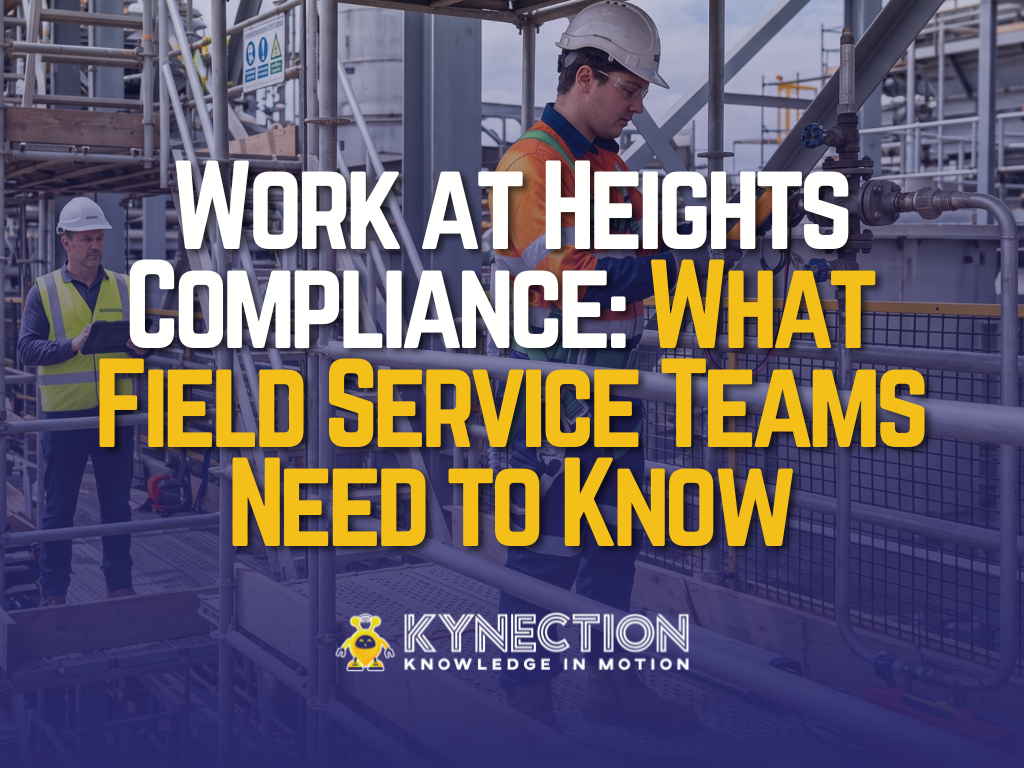
Falls from height are one of the leading causes of workplace fatality in Australia. According to Safe Work Australia’s Key Work Health and Safety Statistics 2025, 24 workers died from falls from height in 2024, accounting for 13% of all workplace fatalities. For field service workers in construction, utilities, facilities management and telecommunications, height work is routine. The risk is not theoretical.
Many field service businesses have safety measures in place. Hard hats, harnesses, a pre-start briefing on a good day. But having some measures is not the same as having a documented, consistently applied compliance programme that would hold up to a regulator visit or a coronial inquiry. The gap between the two is where incidents happen.
This article covers what work at heights compliance actually requires under Australian law, where field service teams most commonly fall short, and what a sound compliance programme looks like in practice.
Key Takeaways
- Falls from height are a leading cause of workplace fatality in Australia, with field service workers among those most at risk.
- Work at heights compliance is a legal obligation under harmonised WHS legislation for any task where a person could fall 2 metres or more.
- A compliant programme covers risk assessment, control selection, competency verification and documented permit-to-work processes.
- The hierarchy of controls applies: PPE is always the last line of defence, not the first.
- Worker tickets must be current before every job, not just at onboarding.
- Near-miss reporting is as important as incident reporting: most fatal falls are preceded by unreported events.
- Digital tools make it practical to apply these obligations consistently across dispersed field teams.
What Work at Heights Compliance Requires Under Australian Law
Work at heights compliance in Australia sits within the harmonised Work Health and Safety Act and Regulations. The WHS Regulations impose a specific duty on a Person Conducting a Business or Undertaking (PCBU) to manage the risk of falls wherever a worker could fall 2 metres or more. This is not a discretionary obligation: it applies regardless of how brief the task is or how experienced the worker.
The Safe Work Australia Code of Practice: Managing the Risk of Falls at Workplaces (2022) is the primary practical guidance document. It covers risk assessment obligations, control selection, permit-to-work requirements and competency standards. While the Code is not law in itself, a failure to follow it is admissible in proceedings as evidence of a WHS Act breach.
The 2-Metre Rule and When It Applies
The 2-metre threshold is the trigger for the full suite of regulatory obligations. Below that, general duty of care still applies, but the specific fall risk management requirements of the WHS Regulations kick in at 2 metres or above. This includes scaffolding, edge protection, elevated work platforms, and Safe Work Method Statements for high-risk construction work.
State Variations in Height Safety Regulations
The harmonised WHS framework applies in most jurisdictions, but SafeWork NSW, WorkSafe Victoria and Workplace Health and Safety Queensland each publish supplementary codes and guidance. Teams operating across state borders need to be aware that the baseline is national, but specific requirements can vary. A permit-to-work format acceptable in one jurisdiction may not satisfy a regulator in another.
Where Field Service Teams Most Often Fall Short
Most compliance failures in height work are systemic: the process breaks down, not the person. The failure modes are predictable, and safety managers recognise them immediately.
- Risk assessments completed on paper and left in the ute: You sign the document but never deliver it to the worker doing the task, and you cannot update it when site conditions change.
- SWMS that are generic rather than task-specific: A Safe Work Method Statement for “work at heights” is not a compliant SWMS for a specific task at a specific location.
- Competency records that nobody checks: A worker presents their Working at Heights ticket at onboarding and it is never verified again, so an expired ticket goes undetected.
- Bypassing permit-to-work processes: When the job is quick and the supervisor is busy, workers skip the permit because “we’ve done this before”, a shortcut that frequently triggers height incidents.
- Near-misses that go unreported: When nothing visibly goes wrong, teams record nothing, and the organization loses its best opportunity to correct conditions before an incident seriously hurts someone.
Risk Assessment for Work at Heights Tasks
A compliant working at heights risk assessment is specific to the task and the site, which includes:
- Identifying the task and the working height
- Hazard identification (falls, dropped objects, unstable surfaces, weather exposure, fatigue)
- Assessing likelihood and consequences
- Selecting controls from the hierarchy
Teams must document the assessment and make them accessible to the workers performing the task, and review when conditions change. Operations managing multiple active sites often benefit from a live site hazard register that reflects current conditions rather than project-start assumptions.
When a SWMS Is Required
For high-risk construction work involving heights, a Safe Work Method Statement is a legal requirement under the WHS Regulations, not optional. The SWMS must identify the high-risk work, describe the hazards and risks, and specify the controls. Importantly, it must be task-specific: a generic document that could apply to any site does not satisfy the requirement.
Documenting the Assessment: What Records Need to Show
The record needs to show what the hazards were, what controls were selected, who made the assessment, and when. In an investigation or audit, records that lack specificity (or that cannot be produced at all) are treated as evidence that the assessment was not carried out adequately. Paper records stored in a vehicle or a filing cabinet fail this test more often than not.
Applying the Hierarchy of Controls to Height Work
The hierarchy of controls is not a suggestion. It is the legally required framework for selecting controls under WHS legislation, and it applies directly to height work.
Engineering Controls: Removing the Risk at the Source
The hierarchy starts with elimination: can the task be redesigned to remove height work entirely? If not, substitution looks at lower-risk methods. Engineering controls (scaffolding, edge protection, elevated work platforms, fixed access ladders, catch platforms) come next. These are the preferred controls because they protect workers without relying on their behaviour.
Administrative Controls: Permits, SWMS and Pre-Task Briefings
Administrative controls follow: permit-to-work processes, SWMS, pre-start briefings, supervisor sign-off, and task rotation to manage fatigue. These controls are necessary but less reliable than engineering controls because they depend on people following a process every time, under varying site conditions.
PPE for Height Work: What It Covers and What It Doesn’t
Personal protective equipment: harnesses, lanyards, self-retracting lifelines, anchor points. This equipment sits at the bottom of the hierarchy. This matters because PPE does not prevent a fall: it arrests one. A harness cannot protect a worker from the force of a fall if the anchor point is not rated, correctly installed, or regularly inspected. Defaulting to PPE as the primary control for height work is a compliance failure, not a solution.
Competency and Authorisation for Height Work
Workers must hold a current Working at Heights ticket before performing height work. The obligation applies before each job, not just at the point of hire. The relevant training unit for most construction and resources environments is RIIWHS204E Work Safely at Heights; UETTDRRF06 applies in electrical and utilities settings.
Employer Obligations Around Licence Verification
The employer’s obligation is to verify currency, not simply to ask. Relying on a worker’s word that their ticket is current does not satisfy the duty to manage risk. The same principle applies to contractor compliance records: the obligation to verify sits with the PCBU, not the subcontractor. If a worker is authorised to perform height work and that authorisation is based on an expired ticket, the PCBU may be exposed.
Keeping Competency Records Current Across a Dispersed Workforce
For field service teams operating across multiple sites, managing this through a shared spreadsheet or memory is not workable. Tickets expire at different times, workers move between crews, and there is no alert when a record lapses. As part of a broader field services safety management protocol, a live competency register, showing who is authorised, what they hold, and when it expires, is the practical mechanism for meeting this obligation.
Near-Miss Reporting and Incident Management for Height Work
Most fatal falls are preceded by unreported near-miss events. Near-miss capture sits at the centre of any sound QHSE management approach for high-risk field work. A worker slips on a platform and catches themselves. A lanyard clips awkwardly onto an anchor point that was not checked before the worker went to height. Nothing happens, so nothing is reported. The organisation never learns that the condition exists.
Why Near-Misses Are the Warning Signs Most Teams Miss
A good near-miss reporting process is fast, mobile-accessible, and low-barrier for the worker. If completing a report takes more effort than the near-miss itself seemed to warrant, workers will not report. The process needs to work on a mobile device, in field conditions, in under two minutes.
WHS Notification Obligations After a Height Incident
Under WHS legislation, a serious injury or illness must be notified to the relevant regulator immediately. A “dangerous incident” (which includes a fall from height that could reasonably have been expected to cause serious injury) must also be notified. The regulator must not be disturbed at the scene before attending. Understanding these obligations in advance, not in the aftermath of an incident, is part of a compliant programme.
Near-miss and incident data should feed directly back into risk assessments and pre-task briefings. If a near-miss identifies an anchor point that fails inspection, the corrective action needs to be assigned, tracked and closed out, not added to a log and forgotten. Incident reporting software that links each logged event to an investigation task makes this connection automatic.
How Technology Supports Consistent Work at Heights Compliance
Applying all of the above consistently across multiple sites, crews and projects is extremely difficult with paper-based systems. The problem is not knowledge: most safety managers know what good looks like. The problem is execution at scale, in real field conditions, with workers under time pressure.
Digital tools solve specific, practical problems in height compliance:
- Pre-populating risk assessments with site and task data reduces the time to complete them and makes generic SWMS less likely.
- Mobile checklists guide workers through pre-task requirements before they start, at the base of the ladder, not at the office.
- Digital permits are issued, approved and recorded in the system, with a timestamp and an authorisation chain that paper cannot replicate.
- Automated alerts trigger when a competency record is approaching expiry, before a worker with a lapsed ticket is assigned to a height task.
- Near-miss capture on a mobile device removes the friction that suppresses reporting.
- Every record (assessment, permit, competency, incident) is available for audit without a paper trail search.
Kynection is built for field service environments: it brings these capabilities into a single system that works on site, in variable connectivity conditions, and connects back to the office in real time. For teams evaluating their options, a comparison of field service management tools shows what compliance-first platforms do differently.
Building a Work at Heights Programme That Holds Up on Site and in an Audit
Work at heights compliance is not a one-time exercise. It is a programme that needs to work every time: on every site, with every crew, before every job. The legal obligation is clear, the failure modes are predictable, and the consequences of getting it wrong are severe.
A sound programme covers the legal baseline, applies the hierarchy of controls consistently, verifies competency before each job, runs a permit process that is not optional, and captures near-misses before they become incidents. The records that demonstrate all of this need to be produced quickly and clearly when a regulator, a client or a court asks for them.
For field service teams, the practical barrier to consistent compliance is not intent. It is process. The right tools make the process fast enough and simple enough that workers will actually use it, in the conditions they work in.
Ready to See What Consistent Compliance Looks Like in the Field?
Managing work at heights compliance across a field team takes more than a checklist. If you want to see how Kynection brings risk assessments, permits, competency records and incident capture into one system built for site conditions, contact the team or book a demo to see it in action.
Frequently Asked Questions
What height triggers a formal risk assessment obligation under Australian WHS regulations?
The WHS Regulations require a PCBU to manage the risk of falls wherever a worker could fall 2 metres or more, triggering obligations for risk assessment, control selection and documentation. General duty of care applies at any height, but the full regulatory requirements activate at the 2-metre threshold.
Is a Working at Heights ticket a legal requirement, or just industry practice?
A Working at Heights ticket is not a legislated high-risk work licence in most Australian jurisdictions, but employers have a duty under WHS legislation to verify that workers are competent before performing height work. A ticket from a registered training organisation is the accepted standard for demonstrating that competency.
What must a Safe Work Method Statement for height work include?
A SWMS must identify the high-risk work, describe the specific hazards and risks, and specify the controls to be applied, and it must be task-specific and site-specific, not a generic template. Workers must have access to the SWMS before and during the task.
Who is responsible for verifying a worker’s competency before a height task?
The PCBU holds the duty to verify competency, which means actively confirming that a worker’s ticket is current, not simply asking them. In subcontracting arrangements, the principal contractor retains that verification obligation for all workers on site.
What are the WHS notification obligations after a fall or near-miss?
A serious injury or illness must be notified to the relevant state or territory WHS regulator immediately, and a dangerous incident (including a fall that could reasonably have caused serious injury) carries the same obligation. Failure to notify is a separate offence under WHS legislation.
How long must height safety compliance records be kept?
Incident and notifiable incident records should be kept for at least 5 years as a general guide, while competency records and SWMS are typically retained for the project duration plus an additional period. Confirm exact requirements with your state or territory WHS regulator.

Ready to take your business to the next level?
Discover how Kynection can help streamline your operations, improve efficiency, and drive growth. Book a demo today and see the difference for yourself!